Chunyu Qu

PhD Student · Neuro-Cognitive Psychology

LMU Munich · MSense Lab ↗

How does the brain carry one moment into the next? I model how recent experience shapes time, space, and choice—and trace these dynamics in behavior and the brain.

Chunyu Qu

Selected research

All publications →

First Author · Preprint · 2026

How does the past shape perception?

A computational account of serial dependence across sensory and contextual transitions, using precision-weighted updating.
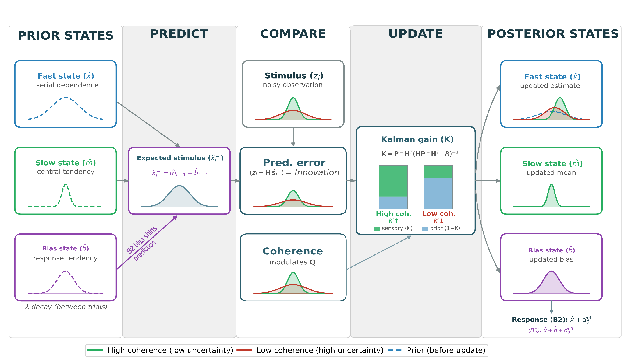
Diagram of the three-state Kalman filter model

Dependence on history emerges from precision-weighted inference across perceptual, memory, and decision states—without an ad hoc learning rule.

Precision-Weighted Updating Explains Serial Dependence Across Sensory and Contextual Transitions
First Author · Preprint · 2026

Why does time pass quickly when we scroll?

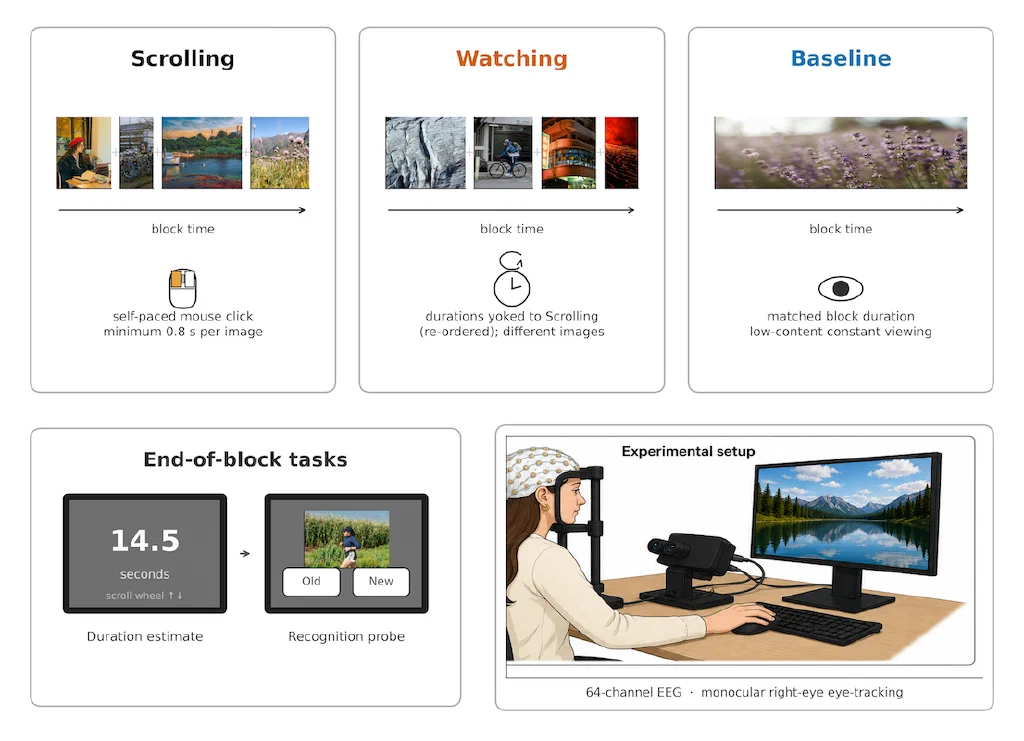
In a study of 23 adults, we compared self-paced scrolling, passive viewing, and a static baseline while recording EEG and eye movements.

Study diagram showing Scrolling, Watching, and Baseline conditions, duration and recognition tasks, and the EEG and eye-tracking setup.
Experimental design and recording setup. Figure: MSense Lab. Click the figure to enlarge.

Self-paced scrolling felt shorter than passive viewing, even after accounting for gaps between images. These findings are preliminary.

The Attentional Thief: How Self-Paced Visual Exploration Compresses Subjective Time

Research focus

Serial dependence

How past responses bias current perception across sensory modalities and contexts.

Time and space

How the brain combines information across temporal and spatial dimensions.

Neural dynamics

Modeling how information carries over between trials in behavior and neural recordings.

Explore my research program →