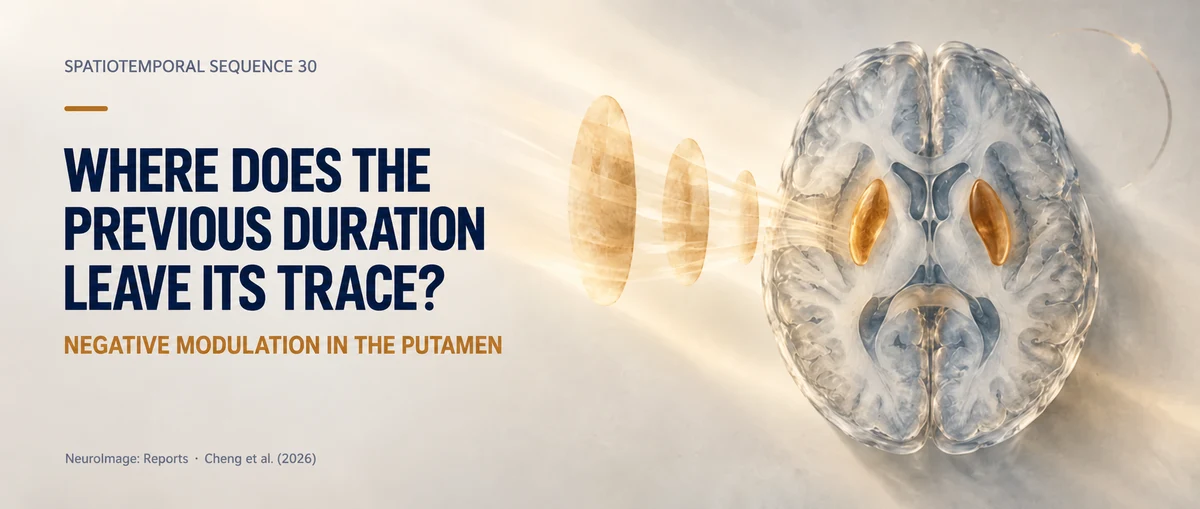
Where does the previous duration leave its trace?
Duration and direction carried different histories in the same moving-dot stimulus. In 27 participants, previous duration negatively modulated bilateral putamen activity.
27 September 2026

An interval stretches, a familiar place bends, and what happened a moment ago quietly changes what we perceive now. These essays follow such disturbances from lived experience into experiments, neural mechanisms, and machines that try to read the brain.
Questions and arguments across psychology, neuroscience, artificial intelligence, and everyday experience.
View collection →Readings on time, space, memory, decision, neural dynamics, and cognitive maps.
View collection →Brain-computer interfaces and neural technology beyond offline algorithm performance.
View collection →Recently published
Duration and direction carried different histories in the same moving-dot stimulus. In 27 participants, previous duration negatively modulated bilateral putamen activity.
27 September 2026
A phrase can become a convention without any model changing its weights. Long interaction, shared memory, and pressure to coordinate may be enough.
27 September 2026
When the device is also the user’s communication channel, consent has to follow surgery, software, and neural data across the entire life of the implant.
27 September 2026
A duration experiment separates how strongly past experience enters the present estimate from how strongly the latest sensation rewrites the next prior.
26 September 2026
The insula, supplementary motor area, heartbeat signals, and bodily dynamics all correlate with timing. The harder question is what role the body plays in the computation.
25 September 2026