Research Program
How the past shapes perception and decisions, studied with computational models, neuroimaging, and data from multiple species
What I Study
Perception is not a snapshot. What we saw and judged a moment ago biases what we perceive now — a phenomenon called serial dependence. My research asks how the brain carries this history: which parts of the past are kept, how strongly they weigh on the present, and how their readout is controlled by the current task.
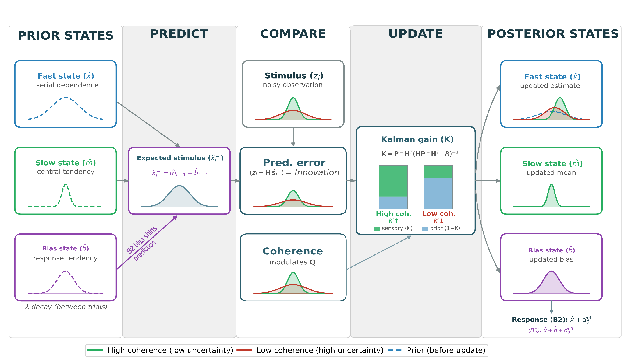
I build generative models — Kalman filters and latent dynamics models in which dependence on history emerges from Bayesian inference — and test their predictions in human behavior, fMRI and EEG, in mouse calcium imaging, and in brain-computer interfaces that run in real time.
Research Framework
Four stages, one modeling pipeline
Integration
New input is weighted by its reliability
Retention
Which parts of the past are kept — and for how long
Readout
How the task at hand controls what history is expressed
Monitoring
How confidence tracks the uncertainty of the readout
Computational Model: The Kalman Filter
The core working model has three latent states: a perception of the current input, a memory that integrates past observations, and a decision that generates the response. In this model each update is weighted by its precision, which reproduces serial dependence across sensory and contextual transitions, without any ad hoc learning rule.
- 1. Perception state: current sensory input
- 2. Memory state: integration of past information
- 3. Decision state: response generation
Across Species: Mouse Calcium Imaging
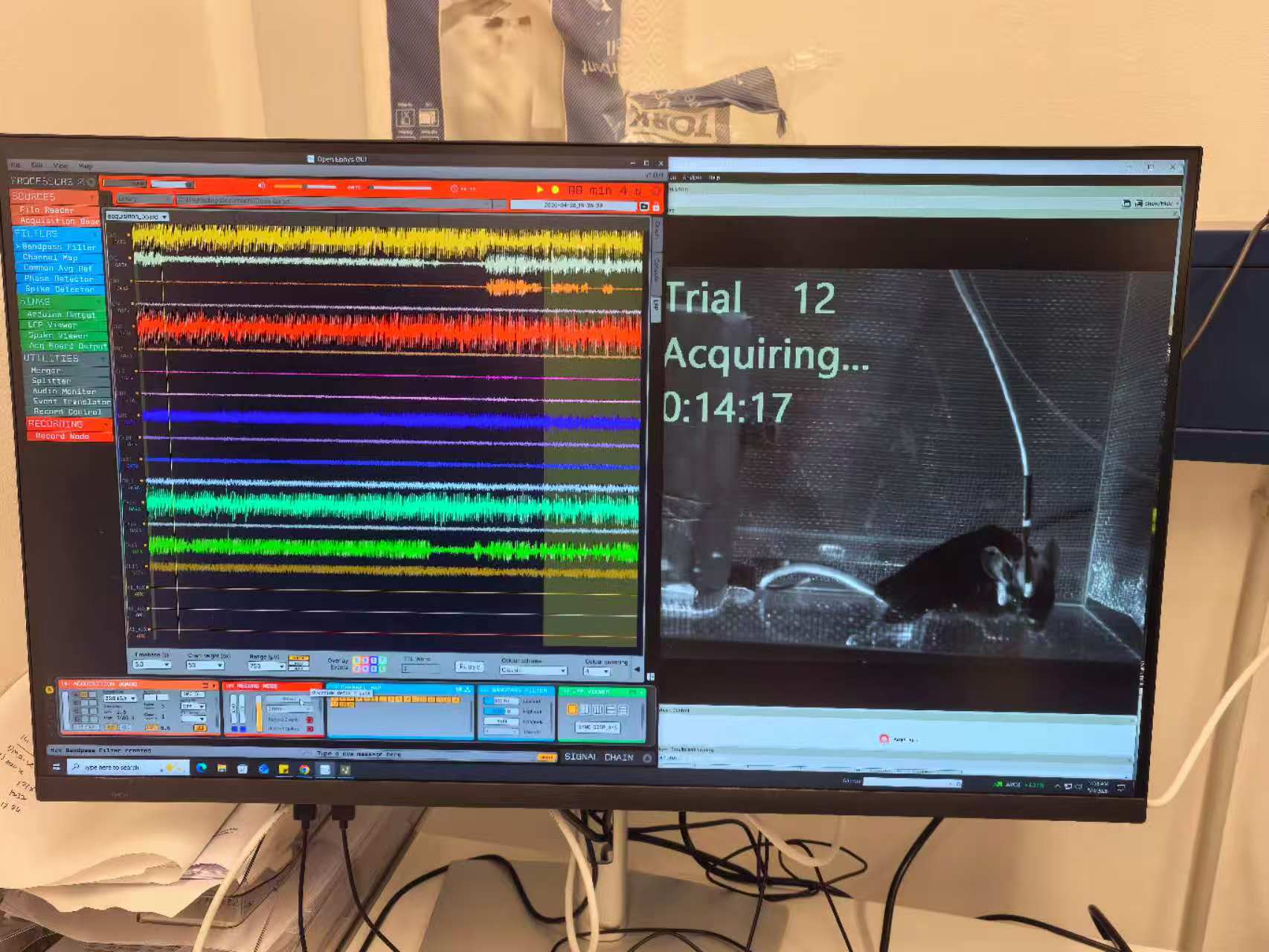
Do neurons in mouse cortex carry the same history from trial to trial? With the Max Planck Institute for Biological Intelligence, I analyze calcium imaging and EMG data — motion correction, ROI segmentation, and neuronal activity visualization — to test how sequential effects look at the neural level, across species.
Status: submitted to Neuron | Partner: MPI for Biological Intelligence
Application: Brain-Computer Interfaces
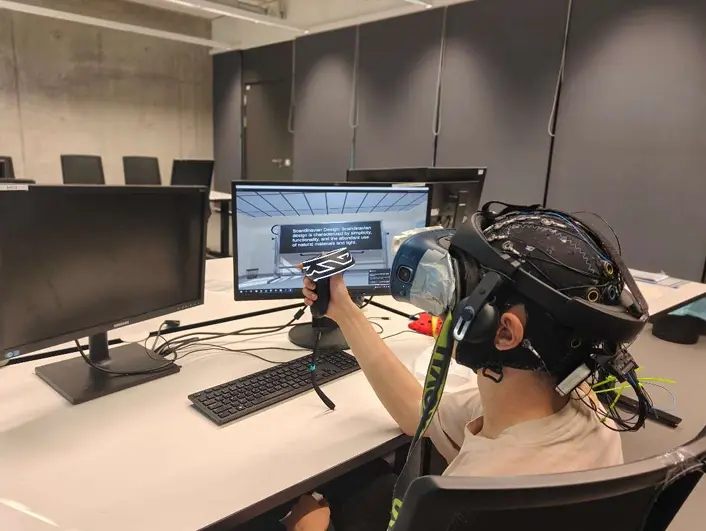
The same inference runs in real time. During my internship at the Munich Institute of Biomedical Engineering (TUM), I built hybrid fNIRS + EEG brain-computer interfaces with visual stimulation in virtual reality — decoding neural signals on the fly, where every millisecond of history matters.
Internship: MIBE, Technical University of Munich | Duration: 05/2024 – 11/2024